Every summer, renters and condo owners experience the same quiet frustration: the balcony has promise, but the lease prohibits permanent fixtures. Drilling even a single hole may result in a security deposit deduction and, in some situations, a formal complaint.
Drilling was never really necessary. When the proper strategy is paired with the right surface, a variety of no-damage ways can keep string lights secure despite wind, rain, and seasons of use.
Why Most “No-Drill” Attempts Fail?
The most common mistake is to handle string lights as if they weigh nothing. A 25-foot strand of S14 bulb lights may weigh 4-6 pounds. A wet or windy night increases the load.
Adhesive hooks specified for 3 pounds on the package are intended for indoor, climate-controlled, smooth wall surfaces, not textured stucco, painted brick, or surfaces that fluctuate between 90°F in July and 30°F in December.
Thermal expansion alone can destroy adhesive bonding on outdoor surfaces. A hook that holds flawlessly in September will tear off a painted concrete wall in February.
Understanding this is what distinguishes long-lasting setups from those that end in a pile of broken glass bulbs on a balcony floor.
Method 1: Adhesive Hooks
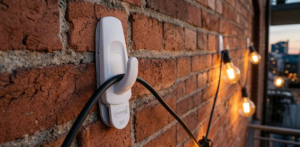
Adhesive hooks work on balconies with smooth, painted drywall or smooth-painted metal surfaces, typically the interior face of an apartment balcony wall or a smooth concrete column. On porous, textured, or unsealed surfaces, no adhesive product performs reliably outdoors.
For surfaces where adhesive is viable, 3M Command Outdoor Hooks (rated 4–7.5 lbs depending on the model) outperform generic alternatives because they use a stretch-release strip designed for removal without damage. The 3M Command product line specifies surface compatibility and outdoor vs. indoor ratings. It is worth reading before purchasing.
Practical setup: Space hooks 4–6 feet apart in a straight or slight catenary curve. Do not run the full strand weight from two endpoints. Install a hook every 4–5 feet so the cable load is distributed. Attach lights using the wire loop at each socket, not by wrapping the wire around the hook. Wrapping creates stress points that cause socket failure at the wire connection.
Surface prep matters more than most guides admit. Clean the mounting area with isopropyl alcohol, wait 60 seconds for it to dry, then press the hook firmly for 30 seconds. Wait 24 hours before hanging any load.
Method 2: Railing Clips and Zip Ties
For balconies with metal or vinyl railings, this is the most structurally sound no-drill method. Plastic cable clips with a screw-tightening collar (often sold as “outdoor wire clips” or “cable clamps”) grip around the railing and hold the wire at a fixed point. They are reusable, weatherproof, and rated to handle the wire weight without stress.
Zip ties work similarly and cost almost nothing, but UV exposure degrades standard black zip ties in 12–18 months outdoors. UV-stabilized zip ties (look for “UV-resistant” or “outdoor-rated” on the packaging) last 3–5 years.
Where this method shines: Running lights along the top railing horizontally, or looping them in a zigzag pattern between the top rail and a tension wire (covered below). Clipping directly to a round or square tube railing takes about 20 minutes for a standard 10-foot balcony.
One limitation: Railing-mounted lights sit lower than overhead strings, which produces a different ambiance — more intimate, less overhead canopy feel. For most balconies under 80 square feet, this is actually a better choice aesthetically, but it is worth knowing before committing.
Method 3: Tension Wire Between Two Anchor Points
This method achieves the overhead canopy effect that renters usually want. A stainless-steel tension wire (also called a guide wire or clothesline cable) is run taut between two existing anchor points — a railing post, a structural column, a fence post, or an exterior wall hook and the string lights hang from the wire using S-hooks or wire clips.
The key is finding two existing structural points that can accept a turnbuckle or wire clamp without damage. In practice, this usually means wrapping a U-bolt clip around the base of a railing vertical post, or securing to an existing eye bolt if one exists on the building exterior.
A 1/8″ stainless steel wire rope with two turnbuckle tensioners provides enough rigidity to prevent sagging under a 10-lb light load across a 15-foot span. The tension wire does the structural work; the string light wire carries no load of its own.
Real-world example: A renter in a Chicago high-rise building (documented on the home improvement forum Apartment Therapy) ran a 1/8″ galvanized wire between two corner railing posts using U-bolt clamps. The wire held a 30-foot strand of G40 globe lights through two Chicago winters without movement—total hardware cost: under $25.
Method 4: Freestanding Light Poles
Some balconies have no railings, smooth stucco walls, and no columns; the exposed concrete slab balcony was common in 1970s and 1980s apartment construction. Here, weighted freestanding poles are the only reliable option.
Shepherd’s hook poles designed for solar lights can be weighted at the base with sandbags or heavy planters. Two poles placed at opposite corners of the balcony, connected at the top by a tension wire, create the same overhead setup as Method 3.
Poles need a minimum base weight of 15–20 lbs each to hold without tipping in wind. A 12-inch terracotta pot filled with concrete or dense soil placed over the pole base is a common and effective solution. Aesthetic-minded setups will wrap the base planter in jute rope or use it as a live planter with low-maintenance succulents.
Choosing the Right String Light for Outdoor, No-Drill Setups
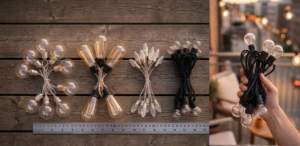
The wire gauge and bulb weight matter more in renter setups because the lights are not being driven through a fixed anchor; they depend on friction, clips, and tension. Heavier bulbs (S14 or G50 globes) on 18-gauge wire will sag between clip points more than lighter C7 or C9 setups on 14-gauge wire.
A practical comparison:
| Light Type | Bulb Weight | Recommended Spacing | Best Method |
|---|---|---|---|
| G40 Globe | Light | Every 4–5 ft | Tension wire, railing clips |
| S14 Edison | Medium | Every 3–4 ft | Tension wire with more support points |
| C7/C9 | Light | Every 5–6 ft | Adhesive hooks, railing clips |
| Bistro (heavy gauge) | Heavy | Every 2–3 ft | Tension wire or poles only |
Weatherproofing matters too. Look for IP44-rated lights at minimum for covered balconies; IP65 for exposed or open balconies. The IEC 60529 standard defines ingress protection ratings — IP44 means the fixture is splash-proof, IP65 means it withstands low-pressure water jets.
Common Mistakes That Lead to Falling Lights
Skipping the surface test. Before committing to an adhesive method, press a strip of painter’s tape to the wall and remove it after 24 hours. If the paint or surface material lifts, adhesive hooks will fail and may take paint or stucco with them.
Over-tensioning the wire. A slight sag (catenary curve) in the string is not a flaw; it is how the wire distributes load evenly. Running lights perfectly level requires enormous tension at the anchor points and increases the risk of failure. Aim for 2–3 inches of sag across a 10-foot span.
Using a single circuit for too many lights. A standard 15-amp outdoor circuit handles about 1,800 watts. A 25-foot strand of 25 S14 incandescent bulbs at 11W each draws 275 watts. Four strands bring that to 1,100 watts, manageable. Switching to LED equivalents (typically 1–2W per bulb) eliminates this concern and reduces heat at the socket connections, extending the life of the clip and adhesive attachment points.
Forgetting the extension cord rating. An outdoor-rated extension cord (marked “W” or “WA” on the jacket) is required for any balcony setup. Indoor extension cords exposed to moisture can arc at the connection and present a fire risk.
Frequently Asked Questions
How do renters handle the power cord without drilling?
Route the power cord along the bottom of the railing using clips or zip ties, then through the balcony door gap using a flat extension cord adapter (a thin, flat plug-through-door cord available at most hardware stores). This avoids drilling a conduit hole while keeping the cord protected.
Is fishing line ever a viable support method?
Occasionally used as an invisible secondary support, 100-lb-rated monofilament can help maintain spacing between bulbs on a horizontal run. It is not a primary structural support; it cannot bear the weight of a full strand alone, but it works well aesthetically to keep lights evenly spaced on a tension-wire setup.
What if the balcony has glass panel railings?
Glass panel railings offer no practical clamp attachment. For these balconies, freestanding poles or a combination of adhesive hooks on the ceiling soffit (if present) and a weighted planter base are the two options. Glass-mounted suction cup hooks rated for outdoor use exist, but are not reliable for more than very lightweight C7-type strands.
How do solar-powered string lights change the setup?
Solar lights eliminate the extension cord problem, which simplifies routing and removes the need for a weatherproof extension cord. The trade-off is that solar panels require direct sun exposure for 6–8 hours daily to maintain full brightness, which many apartment balconies, especially those facing north or shaded by overhangs, cannot reliably provide.