From wayward doorknobs and moving day scuffs to the unavoidable settling fissures of an old foundation, interior walls are subject to considerable wear and tear. The conventional solution is a new coat of paint, which serves as a skin rather than a structural repair. It needs hours of unpleasant spackling and sanding, draws attention to uneven plaster, and is unable to bridge deep gouges.
Alternative wall coverings provide useful, fashionable options when repainting is not feasible, whether because of time limits, rental lease restrictions, or the extent of surface damage. Strategic material selection that strikes a balance between cost, durability, and aesthetic appeal is necessary to cover wall flaws.
Diagnosing the Damage Before Covering
Cosmetic fixes are highly effective for surface-level wear, but they cannot replace structural integrity.
A standard industry benchmark is the 1/8-inch rule. Hairline cracks caused by natural building settling or minor temperature fluctuations are generally harmless.
Conversely, cracks wider than 1/8 inch, those that show active expansion, or surfaces suffering from severe moisture retention (seelan) indicate structural or plumbing issues that require professional assessment before any cosmetic covering is applied. Ignoring these root causes can lead to safety hazards and ruined decor materials down the line.
For spaces dealing with historical moisture issues, the U.S. Environmental Protection Agency (EPA) provides guidelines on indoor moisture control, emphasizing the importance of ventilation. Once the underlying wall is deemed structurally sound and dry, aesthetic coverings can be safely installed.
The Architectural Upgrade: 3D Panels and Wood Slats
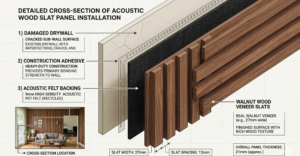
For walls with heavy, uneven damage like crumbling plaster or multiple anchor holes, rigid paneling provides an entirely new surface.
Wood Slat and MDF Paneling Vertical wood slat panels have transitioned from mid-century modern staples to highly accessible solutions for concealing wall cracks. These panels often feature a real wood veneer over an acoustic felt backing, providing both visual depth and sound dampening. Paintable MDF panels offer another route, arriving pre-primed and ready to match existing room palettes.
Because rigid panels physically protrude from the wall, they create a highly effective shield against high-traffic impacts in entryways and corridors. However, this physical depth comes with a distinct trade-off: deep, bold 3D panels can visually enclose compact spaces, making small rooms feel smaller.
To mitigate this, design experts recommend limiting heavy 3D paneling to a single accent wall in smaller rooms.
Cost and Installation Metrics
- Material Costs: 3D wall panels generally range from $5 to over $40 per square foot, depending on the complexity of the design and the material (MDF vs. natural wood veneer).
- Installation: Permanent application relies on heavy-duty construction adhesive. A level must be used to ensure the first vertical column is perfectly straight, as subsequent panels will follow its lead.
The Soft Camouflage: Fabric and Drapery Solutions
Textiles offer a forgiving, highly adaptable way to hide large swaths of damaged drywall without the permanence of construction adhesive.
The Liquid Starch Fabric Wall. For a wallpaper effect without the permanent commitment, lightweight cotton fabric adhered with liquid starch is a proven technique. This method costs under $50 for an average-sized accent wall and leaves the underlying drywall entirely undamaged upon removal.
Because liquid starch shrinks cotton fabric as it dries, exact measurements require a buffer. An extra six inches of fabric should be cut for the length to accommodate this shrinkage.
The installation involves rolling liquid starch directly onto the wall, tacking the fabric at the top ceiling line, and rolling more starch over the face of the fabric to smooth out bubbles.
Once allowed to dry overnight, the hardened excess fabric at the baseboards is sliced away with a razor blade.
Wall-to-Wall Drapery When dealing with a highly textured or crumbling wall, hanging floor-to-ceiling curtains acts as an immediate mask. Utilizing a continuous ceiling-mounted track system allows a single expansive fabric panel to serve as a soft background.
Beyond hiding imperfections, dense fabrics like velvet or heavy linen blends absorb mid- and high-frequency sounds, drastically reducing echo in open-plan studios.
Real-World Scenario: The Functional Cork Board Wall
Transforming a damaged wall into a massive, functional bulletin board requires careful execution to avoid destroying the underlying drywall further.
In a notable real-world application, a 4-foot by 8-foot cork wall was constructed for approximately $85, turning a blemished bedroom wall into an organizational focal point.
The Implementation Process:
- Protecting the Drywall: Heavy-duty rubber cement is required to keep thick cork from peeling. Because rubber cement permanently damages drywall, a 4×8-foot sheet of thin birch paneling ($10) was first securely anchored directly into the wall studs using approximately 40 screws.
- Ventilation: Industrial rubber cement emits strong fumes. Applying the adhesive requires fully opened windows and proper respiratory masks.
- Adhesion and Pressure: The rubber cement was rolled onto both the birch panel and a 6mm thick cork sheet ($53). The cork was applied to the wood and smoothed heavily with a standard kitchen rolling pin to ensure absolute contact.
- Finishing: After an hour of curing, the excess cork was trimmed, and the raw edges were framed out with basic 1.5-inch baseboard trim ($10).
This method successfully hides the original wall, provides a highly durable acoustic dampener, and leaves only easily patchable screw holes if the entire apparatus is eventually removed.
Decals, Wallpapers, and Gallery Hacks
For minor hairline cracks, localized discoloration, or small anchor holes, heavy-duty construction is unnecessary.
Thick Wallpapers and Vinyl Decals.
Wallpaper has been utilized since the Medieval period to conceal wall flaws. However, thin or glossy wallpapers tend to telegraph the exact texture of the damage underneath, highlighting rather than hiding the problem.
Thick, heavily textured wallpapers or faux concrete finishes provide the necessary thickness to camouflage hairline cracks and uneven surfaces. For tiled walls suffering from chipped glaze or minor cracks, vinyl tile decals can be applied directly over the existing surface to change the visual pattern completely.
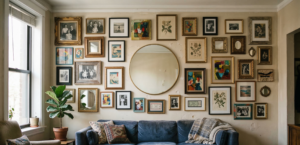
Strategic Artwork Placement Gallery walls utilize visual distraction. By assembling a collection of framed art, mirrors, and wall-hung shelves, the eye is drawn to the decor rather than the negative space of the wall. Mirrors are particularly effective as they reflect ambient light, making the room appear larger while simultaneously covering localized damage.
Comparison of Wall Covering Methods
The following breakdown assists in selecting the proper intervention based on the severity of the wall damage and the permanence of the solution.
| Method | Best For | Estimated Cost | Permanence |
|---|---|---|---|
| 3D Wood/MDF Panels | Deep cracks, heavy texture, high-traffic scuffs | $5 – $40 / sq. ft. | Permanent (Adhesive) |
| Liquid Starch & Fabric | Minor stains, dull paint, rental properties | < $50 total | Temporary / Removable |
| Birch & Cork Board | Mid-wall damage, creating functional space | ~$85 total | Semi-Permanent (Screws) |
| Ceiling Track Curtains | Crumbling plaster, acoustic issues | Variable based on fabric | Semi-Permanent (Anchors) |
| Textured/Heavy Wallpaper | Hairline cracks, minor unevenness | $1 – $10 / sq. ft. | Semi-Permanent (Paste) |
Final Assessment for Flawless Walls
It is not strictly necessary to use sanding blocks, buckets of spackle, and several coats of volatile paint to restore a room’s aesthetic value. The story of the room is completely altered by using the wall as a blank canvas for fabrics, architectural panels, or useful cork installations.
The most effective low-cost décor fixes depend on matching the appropriate material to the structural reality of the wall’s damage. Damaged walls present an unexpected opportunity to enhance an interior’s overall design, whether you utilize the acoustic density of thick draperies or the crisp, contemporary forms of fluted MDF.